The pitch is usually simple: “If everyone invites three people, our church will grow exponentially.” Some churches adopt a more realistic “each one, bring one” model. Regardless of the exact words, churches usually set growth goals based on the assumption Jesus taught a “multiplication model,” which always yields exponential growth.
While short-term exponential growth may be possible, ChurchSalary’s research indicates that sustainable, real-world growth almost always follows a logarithmic (or logistic) curve as new members become harder to attract and assimilate as church organizations become increasingly complex. This logarithmic trend impacts not just churches but salary growth for pastors as well.
Even the best methods at bypassing this trend—church planting and/or multisite churches—will inevitably encounter constraints.
Series Overview
Learn more about how staffing and compensation changes as churches grow. And how your church can adapt.
- Average Per Person Giving in the Church
- How Much Does the Average Church Spend on Payroll?
- How Many Staff Members Should Your Church Have?
- Three Key Complexity Hurdles That Churches Face
- Connecting the Dots Between Church Metrics and Compensation
Two trends
If you analyze the relationship of church size to average senior pastor salary as well as to the frequency of congregations, two logarithmic (or power) growth curves emerge.
What is happening here? And what can these curves tell us about growth and staffing in the church?
Three types of growth
There are three basic types of growth that apply to churches and staff pay.
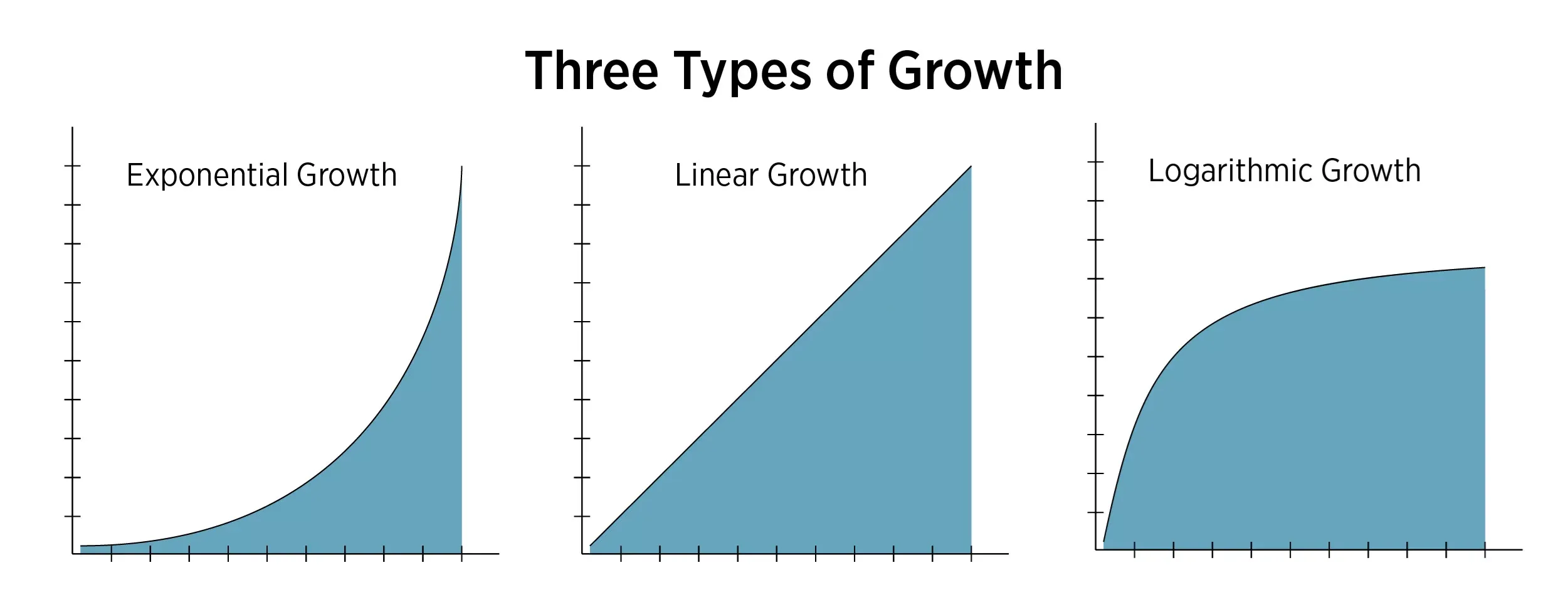
Exponential growth starts slow, then rapidly increases.
During the pandemic, scientists explained that the Omicron variant had a terrifying growth rate or “R naught” of seven — i.e., every sick person will infect, on average, seven other people. Despite these predictions, the infection rate of each variant eventually slowed down. Why?
Linear growth remains constant over time.
Linear growth is constant; it neither accelerates nor decelerates. In the real world, linear trends over a long period are hard to find. Even seemingly simple relationships such as church budget to attendance don’t follow a linear pattern.
Logarithmic growth starts fast, then slows down.
Logarithmic growth is the inverse of exponential. One way to conceive of a logarithm is that the amount of time it takes to achieve the same result grows larger. For example, the average salary of a senior pastor doubles as the church grows from 30 to 300 people, but in order for their salary to double a second time the church must grow from 300 to over 3,000 people.
While logarithmic growth may not seem very intuitive, we encounter it every day.
We experience the world logarithmically
Logarithms explain how we perceive the world through our senses.
For example, the Weber-Fechner law explains that the just-noticeable difference between two stimuli—extra weight, louder noise, brighter light—follows a logarithmic scale. This is why we use log scales to measure a host of natural phenomena: sound intensity (decibels), star brightness (lumens), earthquakes (Richter scale), wind intensity (Beaufort scale), mineral hardness (Mohs scale), and acidity (pH scale). We simply perceive the world through a logarithmic lens—the same applies to numerical growth.

Older church members remember past attendance growth more fondly and present growth never compares because of the Weber-Fechner law. When your church grew from 100 to 200 people everyone noticed that the church doubled in size, but when your congregation grows in the present from 2,000 to 2,100 nobody notices. Why? Even though both growth spurts added 100 souls, the first one feels 10 times more significant.
This is why founding or historical pastors get so much credit for growing the church versus current pastors. Even though your Pastor Emeritus only added 500 people and your current pastor has added 1,000, the first 500 will always feel more monumental.
This law of logarithmic perception even explains how time appears to pass by faster and faster as we age. As Maximilian Kiener explains in this amazing visualization:
“When you are 4 weeks old, a week is a quarter of your life. By the end of your first year, a week is only a fiftieth of your life. By the time you turn 50, a whole year will be a fiftieth of your life.”
What Causes Growth to Slow Down?
God designed constraints and limitations into the world: space is limited and food only grows so fast. Were it not for these constraints, Earth would long ago have become a soup of viruses and bacteria.
Your church encounters growth constraints in the form of limited seats, limited staff, and limited stuff (money, resources), and limited time. You need empty seats, a larger staff, more volunteers, a bigger budget, and more time to both fuel and sustain growth.
Unfortunately, each of these constraints are often coupled with other constraints. This creates a feedback loop or cycle that slows down growth in even the most dynamic churches.
- You need empty seats to grow.
- If you grow attendance, you need more staff to care for them.
- To hire more staff, you need more money.
- But budget growth usually lags behind numerical growth (tithing is taught or caught).
- To create more empty seats, you often need a bigger facility, which costs more money.
This feedback loop of constraints repeats for churches, ad infinitum. In practice, it usually creates expansion and contraction cycles.
The only “easy” way to temporarily bypass these constraints is by starting a new congregation (church planting) or a new campus (multisite churches). But even these approaches simply delay the inevitable because all churches face two additional obstacles: complexity and competition.
Complexity
As a church grows, its staffing, budget, and structures become exponentially more complex.
Every small group pastor learns in seminary that relationships increase rapidly as group size increases based on the formula X = [N * (N-1) /2].
Practically, this means that a small group of 10 people creates 45 potential relationships—enough for a part-time Sunday School or small group leader to manage. But a congregation of 100 people creates 4,950 potential heartaches, conflicts, and celebrations that only a full-time pastor and team of volunteers can hope to tackle. By the time a church reaches 1,000 people the number of potential relationships explodes to an eye-popping 499,500!
The need to manage these relationships creates a demand for more and more paid staff. But the same relational complexity arises between staff members. For example, even though you might assume managing 21 employees versus 3 is only 7 times more complex, the reality is feels 70 times harder because of the number of relationships between all 21 employees.
Complexity is also the reason why senior pastor salaries follow a logarithmic (or power) trend.
As the church grows, every additional dollar must be divided into smaller and smaller slices to pay for more staff and more programs or events. This causes salary growth for senior pastors relative to the church budget and attendance to decrease. More and more of the additional budget dollars must go to paying for more and more staff, that leaves less and less as a percentage to go towards the senior pastor.
If the senior pastor's salary overshoots it's growth trajectory, this can actually rob the church of money it needs to grow and retain staff. The senior pastor can essentially shoot themselves in the foot by accepting a raise that is too large.
Competition
The final constraint that all churches face is competition for congregants. Pastors have a term for this—“sheep stealing.” Even though very few pastors set out to steal sheep, the reality is that finding, converting, and discipling lost people is exponentially harder than assimilating already-discipled believers.
Competition among churches in a community is a function of supply and demand. How many churches (supply) and how many churchgoers are present in the community (demand)? Churches situated in counties or cities experiencing population growth will find it easier to grow as a steady stream of “ready-made” churchgoers move into town. However, exponential growth rates simply are not possible in communities experiencing negative or stagnant population growth.
Closing thoughts
The same pattern of logistic growth likely occurs every time the Gospel is introduced into a new country or people group: slow initial growth that eventually explodes into rapid exponential expansion that transitions into slower logarithmic growth. The pace of growth that a church can expect will depend on where they fall in this lifecycle.
Church growth campaigns are great. Asking for a raise because you generated growth at your church is not a bad thing. Jesus is clear, “the worker deserves his/her wage.” But every church leader must bear in mind that the constraints of resources, staffing, complexity, and competition are conspiring to slow down both the growth of both your church and your salary.
Church planting (and/or multisite churches) can be fruitful and lead to rapid organizational growth because they are able to bypass some of these constraints. However, no matter how well designed they are, these new strategies cannot bypass growth constraints forever.
Future planning at your church should acknowledge and anticipate the logarithmic or logistic growth rate changes that pop up everywhere in ChurchSalary’s data—from a decrease in per person giving to key staffing hurdles.